In the 21st century—an era defined by logistics, artificial intelligence, big data, and global trade—that ancient legend seems to tell a completely different story: a story of connectivity.
The Cowherd and the Weaver Girl are not merely two individuals; they represent the two ends of a fundamental need: one side creates value, while the other receives it. The gap separating them is not just the Milky Way; it embodies all the distances humanity must constantly bridge—geographical, linguistic, cultural, institutional, technological, and even those of trust. In the past, that gap was the Milky Way. Today, it takes other forms: oceans, borders, seaports, airports, railways, logistics hubs, transcontinental fiber-optic cables, and the Internet connecting billions of people. The distance itself has never vanished; humanity simply keeps innovating to build bridges that span it.
The legend often speaks of the Magpie Bridge, yet few ask: Who actually built it? It was neither a deity nor a miracle, but the tiny magpies themselves. A single bird, with only one pair of wings, could not construct the bridge alone; yet, tens of thousands of wings uniting could carry two lovers across the vast expanse of the Milky Way—this is the very philosophy of a network. In modern logistics, no container reaches its destination in isolation; no ship completes its voyage without a seaport; no seaport operates without customs; no business survives without suppliers; and no nation can prosper if it isolates itself from the global trade network. Much like the Magpie Bridge, value lies not in the individual, but in the coordination of the entire system.
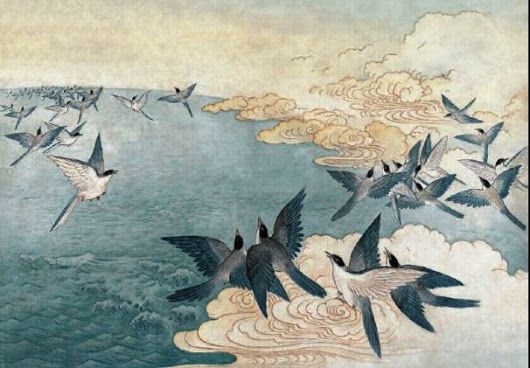
Viewed through the lens of logistics, the O Thuoc Bridge is not merely a bridge; it is a supply chain. Each "O" bird represents a link—a transport vehicle, a customs officer, a driver, a stevedore, a port engineer, a declaration specialist, or a policymaker. Each individual contributes only a small part, yet these small contributions collectively drive the flow of the entire economy. No one notices the individual birds; people see only the bridge. No one remembers the names of individual logistics workers; people see only goods arriving at the right place and the right time. That is the quiet beauty of those who facilitate connections.
Today, when a shipment travels from Asia to Europe, it traverses not only oceans but also numerous "Galaxies" of requirements: customs regulations, tariff barriers, technical standards, quarantine protocols, supply-chain security measures, and trade agreements. While some view these barriers as divisive, from another perspective, they serve as mechanisms to safeguard the economic lifeblood of each nation. A bridge requires not only construction but also management to ensure its sustainability. A smooth flow requires not only speed but also safety, transparency, and accountability. Thus, customs clearance is far more than a mere administrative procedure; it is a ritual that allows the economic flow to transition from one nation's sphere to another's, grounded in mutual respect.
Interestingly, in Han culture, the character *Ô* (烏)—meaning "crow"—evokes more than just the image of a black bird. The legend of "crows feeding their parents" tells of young crows that, upon maturing, feed their aging mothers; thus, the crow symbolizes gratitude and responsibility. Viewed through this lens, each crow represents not merely a pair of wings, but an individual shouldering a share of the task for the common good. The bridge is formed not by brute strength, but by a spirit of responsibility—perhaps the very foundation of all civilizations.
As we enter the era of artificial intelligence, the significance of the *Ô Thước* bridge (the Magpie Bridge) expands further: the Internet connects continents, AI links knowledge, logistics connects economies, and data bridges markets. Yet, all these bridges lose their meaning if humanity forgets the original purpose of connection. Technology may accelerate the movement of goods, AI may process data faster, and robots may work with greater precision, but only humans understand the reason for coming together. The *Thất Tịch* (Qixi) festival celebrates not the bridge itself, but the reason for its creation: love, responsibility, faith, and the yearning to bridge any distance to reach one another. Perhaps this offers the profoundest definition of logistics in a civilized age. Logistics is not merely the transport of goods; it is the art of connecting what is apart. Just as the *Ô Thước* bridge did more than span the banks of the Milky Way—connecting people to one another and to love, linking tradition with modernity, and uniting an ancient legend with the aspiration to build a civilized world—so too are bridges built today not just for the flow of goods, but to allow human hearts to find each other. At Annamnguyen Logistics, we believe that every shipment is more than just a transport journey; it is a journey of connecting trust, creating value, and fostering sustainable partnerships. We do not merely ensure goods reach their destination safely and on time; we accompany our clients at every stage of their growth, demonstrating professionalism, dedication, and responsibility across every link of the supply chain.
"Annamnguyen Logistics – Connecting values, reaching every destination."