International delivery terms serve as the guiding principle and common language in all foreign trade contracts. They not only provide the legal basis for how transportation is to be carried out but also establish the critical boundaries determining who pays, who bears the risk, and when responsibility is transferred. Even the slightest ambiguity in selecting delivery terms can turn a million-dollar deal into a protracted legal dispute.
So, what exactly are the delivery terms based on Incoterms principles? Let’s delve into the details and equip ourselves with the most accurate answers.
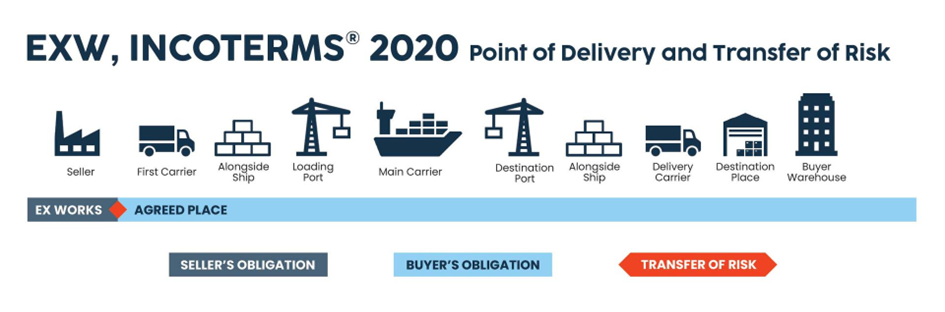
EXW (Ex Works)
EXW means the seller delivers the goods to the buyer when the goods are placed at the buyer's disposal at a named place (such as a factory or warehouse); this named place may or may not be the seller's own premises.
To effect delivery, the seller is not required to load the goods onto a vehicle or complete export customs formalities.
Delivery occurs—and risk transfers—when the goods are placed at the buyer's disposal (without having been loaded onto a vehicle).
ð EXW is the Incoterm that entails the minimum obligation for the seller.
EXW applies to all modes of transport.
The place of delivery is the named place itself.
FCA (Free Carrier)
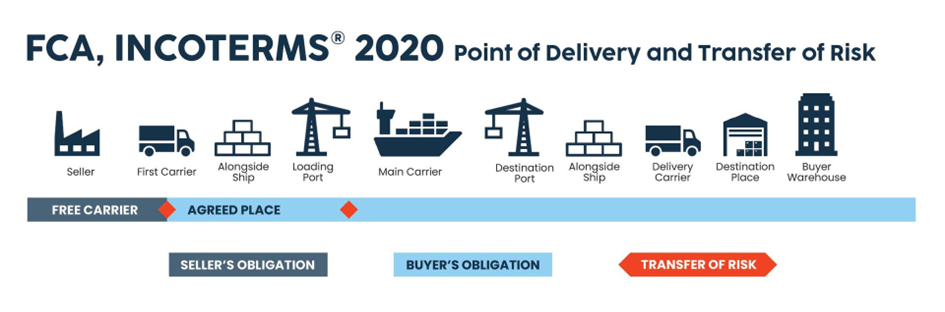
FCA means the seller delivers the goods to the buyer in one of the following two ways:
- When the named place is the seller’s premises, the goods are delivered when loaded onto the means of transport arranged by the buyer; or
- When the named place is another location, the goods are delivered when they have been loaded onto the seller’s means of transport, have arrived at the named place, and are ready for unloading from the seller’s means of transport and at the disposal of the carrier or another person nominated by the buyer.
Whichever of the two locations is named for delivery, that location determines the point at which costs and risks are transferred to the buyer.
FCA requires the seller to carry out export customs formalities in the country of export, such as:
- Export licenses;
- Security clearance;
- Cargo inspection;
- Compliance with any legal regulations.
To make the FCA rule viable for sellers who require an "on-board" Bill of Lading (B/L), Incoterms 2020 FCA rules provide—for the first time—that if the parties have so agreed in the contract, the buyer must instruct the carrier to issue an "on-board" B/L to the seller.
ð FCA applies to all modes of transport.
The place of delivery is the named place.
CPT (Carriage Paid To)
CPT means the seller delivers the goods to the buyer and transfers the risk regarding the goods to the buyer when:
- The goods are handed over to a carrier contracted by the seller, or
- The seller procures goods so delivered for delivery to the buyer.
Once the goods are delivered to the buyer in this manner, the seller does not guarantee that the goods will arrive at the destination in good condition or complete. Risk transfers from the seller to the buyer when the goods are delivered to the buyer by handing them over to the carrier. The seller must contract for the carriage of the goods from the point of delivery to the agreed destination.
ð CPT is used for all modes of transport.
Place of delivery differs from the named place of destination.

CIP (Carriage and Insurance Paid To)
CIP means the seller delivers the goods to the buyer—and transfers the risk regarding the goods to the buyer—when:
- The goods are handed over to a carrier contracted by the seller, or
- The seller procures the goods so delivered for handover to the buyer.
Once the goods are delivered to the buyer in this manner, the seller does not guarantee that the goods will arrive at the destination in good condition or complete. Risk transfers from the seller to the buyer when the goods are delivered to the buyer by handing them over to the carrier.
The seller must contract for the carriage of goods from the point of delivery to the agreed destination.
The seller must purchase insurance for the goods (coverage extending from the point of delivery to at least the destination).
ð CIP is used for all modes of transport.
The place of delivery differs from the named place of destination.

DPU (Delivered at Place Unloaded)
Unlike Incoterms 2010, the DAT (Delivered at Terminal) rule has been renamed DPU (Delivered at Place Unloaded). While the two are fundamentally similar, the ICC intended to emphasize and clarify the seller's obligation to deliver goods to a specific, pre-determined location (such as a railway station, port, ICD, or any other designated point).
This means the seller is responsible for unloading the goods from the transport vehicle onto the ground at the agreed destination. This scope is broader than DAT (which was limited to delivery at a specific terminal or port); under DPU, the delivery point can be any location agreed upon by the seller and the buyer.
Under DPU terms, the seller bears all costs, risks, and responsibilities until the goods have been unloaded from the transport vehicle at the agreed-upon location.
The seller covers all costs incurred prior to the delivery point, while the buyer covers all costs incurred after that point.
The seller is required to contract for the carriage of goods to the designated location.
ð DPU applies to all modes of transport.
The place of delivery is the designated location.

DAP (Delivered At Place)
DAP means the seller delivers the goods to the buyer—and transfers the risk regarding the goods to the buyer—when the goods are placed at the buyer's disposal on the arriving means of transport, ready for unloading at the named place of destination.
The seller bears all risks involved in bringing the goods to the named place of destination. The risk of loss or damage to the shipment transfers to the buyer at the point of delivery.
All costs incurred prior to the point of delivery are borne by the seller, while all costs incurred after that point are borne by the buyer.
The seller must contract for the carriage of goods to the named place.
ð DAP applies to all modes of transport.
The point of delivery is the same as the named place of destination.

DDP (Delivered Duty Paid)
DDP means the seller delivers the goods to the buyer—having cleared them for import—placing them at the buyer's disposal on the arriving means of transport, ready for unloading at the named place of destination.
The seller bears all risks of loss of or damage to the goods involved in bringing them to the named place of destination.
The seller bears all costs incurred prior to the point of delivery (including import clearance costs), while the buyer bears all costs incurred after the point of delivery.
The seller must contract for the carriage of goods to the named place of destination.
ð DDP is applicable to all modes of transport.
The place of delivery is the same as the named place of destination.

FAS (Free Alongside Ship)
FAS means the seller delivers the goods to the buyer when:
The goods are placed alongside the vessel nominated by the buyer at the named port of shipment; or
The seller procures the goods so delivered for delivery to the buyer.
The risk of loss of or damage to the goods transfers when the goods are placed alongside the vessel, and the buyer bears all costs from that moment.
FAS requires the seller to carry out export customs formalities.
ð FAS is used for maritime transport.
The place of delivery is the named place.

FOB (Free On Board)
FOB means the seller delivers the goods to the buyer when:
- The goods are placed on board the vessel nominated by the buyer at the named port of shipment, or
- The seller procures goods so delivered for delivery to the buyer.
The risk of loss of or damage to the goods transfers when the goods are placed on board the vessel, and the buyer bears all costs from that moment onwards.
FOB requires the seller to carry out export customs clearance.
ð FOB is used for sea transport.
The place of delivery is the named place.

CFR (Cost and Freight)
Under CFR, the seller delivers the goods to the buyer when:
- The goods are placed on board the vessel.
- The seller procures the goods so delivered for shipment to the buyer.
The risk of loss of or damage to the goods transfers when the goods are placed on board the vessel; at that point, the seller fulfills their delivery obligation, regardless of whether the goods arrive at the port of destination in good condition and intact.
With CFR, the seller is not responsible for purchasing insurance for the goods; therefore, the buyer must arrange for insurance themselves.
The seller must contract for the carriage of goods from the point of delivery to the named port of destination.
ð CFR is used for sea transport.
The place of delivery differs from the named destination.

CIF (Cost, Insurance and Freight)
Under CIF, the seller delivers the goods to the buyer when:
The goods are placed on board the vessel, or
The seller procures goods already so delivered for shipment to the buyer.
The risk of loss of or damage to the goods transfers when the goods are placed on board the vessel; at that point, the seller fulfills their delivery obligation, regardless of whether the goods arrive at the port of destination in good condition and complete.
Under CIF, the seller is responsible for purchasing insurance for the goods.
The seller must contract for the carriage of goods from the point of delivery to the named port of destination.
ð CIF is used for sea transport.
The place of delivery differs from the named destination.

How should you choose delivery terms for shipping?
In principle, all 11 international delivery terms (Incoterms) can be applied when trading goods between countries. However, certain terms are better suited to specific modes of transport. Therefore, you should select the appropriate delivery terms based on the sales agreement between the two parties.
Specifically:
The terms EXW, FCA, CPT, CIP, DAT, DAP, and DDP are suitable for all modes of transport (sea, air, etc.).
The terms FAS, FOB, CFR, and CIF are suitable for sea transport.
We hope the information shared above has given you a clear understanding of international delivery terms. Applying this knowledge in practice will certainly help ensure smoother international shipping operations for goods coming into Vietnam. Key Delivery Terms Applied by AnNamNguyen Logistics
In international trade, selecting the FOB (Free on Board) delivery term is a strategic decision that enables businesses to optimize costs and gain control over their supply chain. Adopting FOB means proactively securing control over the primary international leg of transport—the stage that typically accounts for the largest share of costs and carries the highest risk. Instead of relying on a partner's arrangements, we have the freedom to select reputable shipping lines, flexibly negotiate competitive freight rates, and determine the shipping routes best suited to our business schedules.
Furthermore, FOB facilitates a clear and transparent delineation of responsibilities at the ship's rail at the loading port. This minimizes unnecessary disputes regarding unexpected costs or the risk of cargo loss during transit. A thorough understanding and proficient application of the FOB method not only demonstrates professional logistics management and tight cost control but also serves as a solid foundation for enhancing competitiveness and establishing a proactive, sustainable position in the global market. This effectively minimizes unnecessary disputes regarding additional costs or the risk of cargo loss during domestic transport. Mastering the FOB method not only demonstrates a professional approach to logistics management and strict cost control but also serves as a solid foundation for enhancing competitiveness and establishing a proactive, sustainable position in the global market.